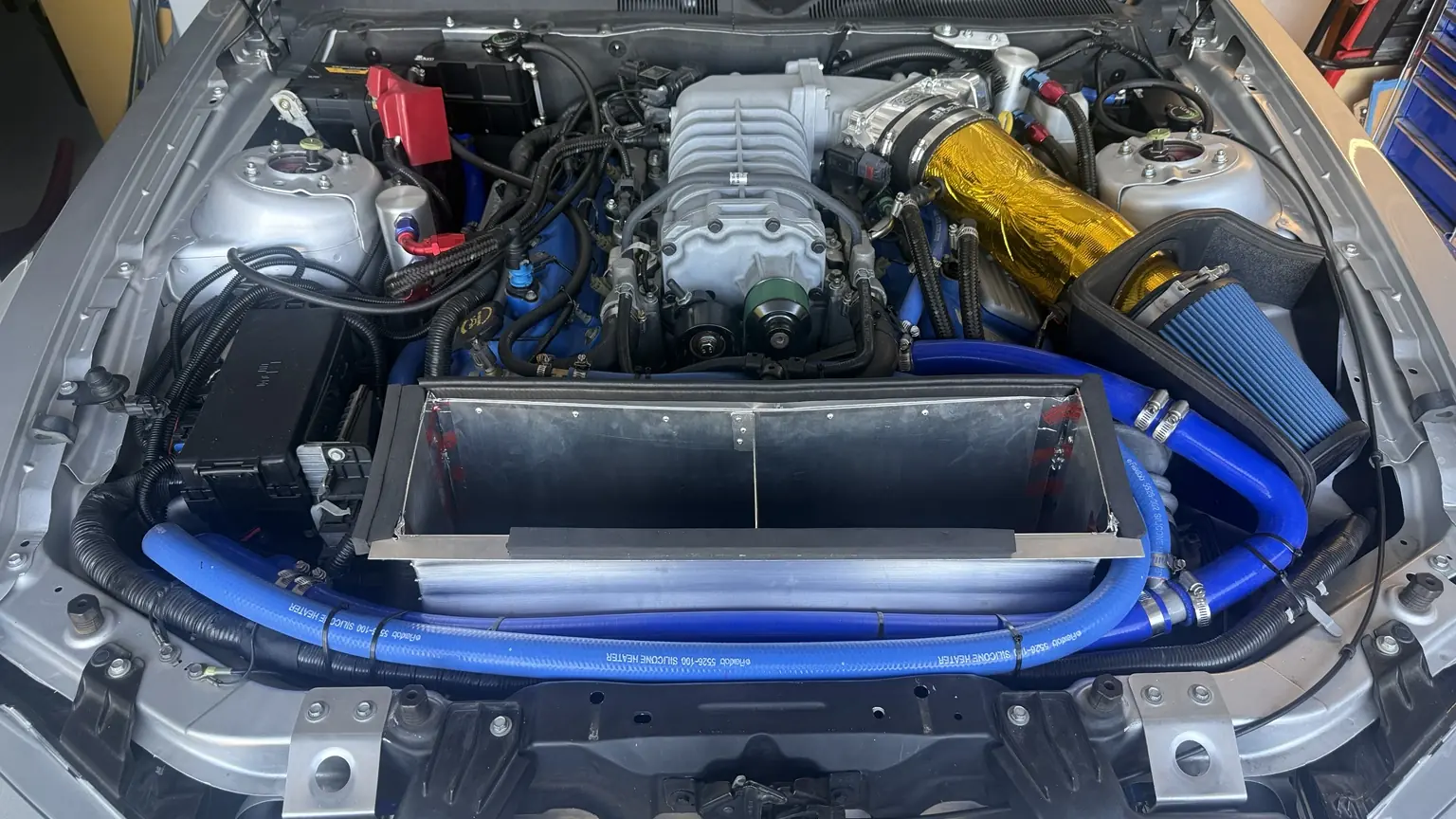
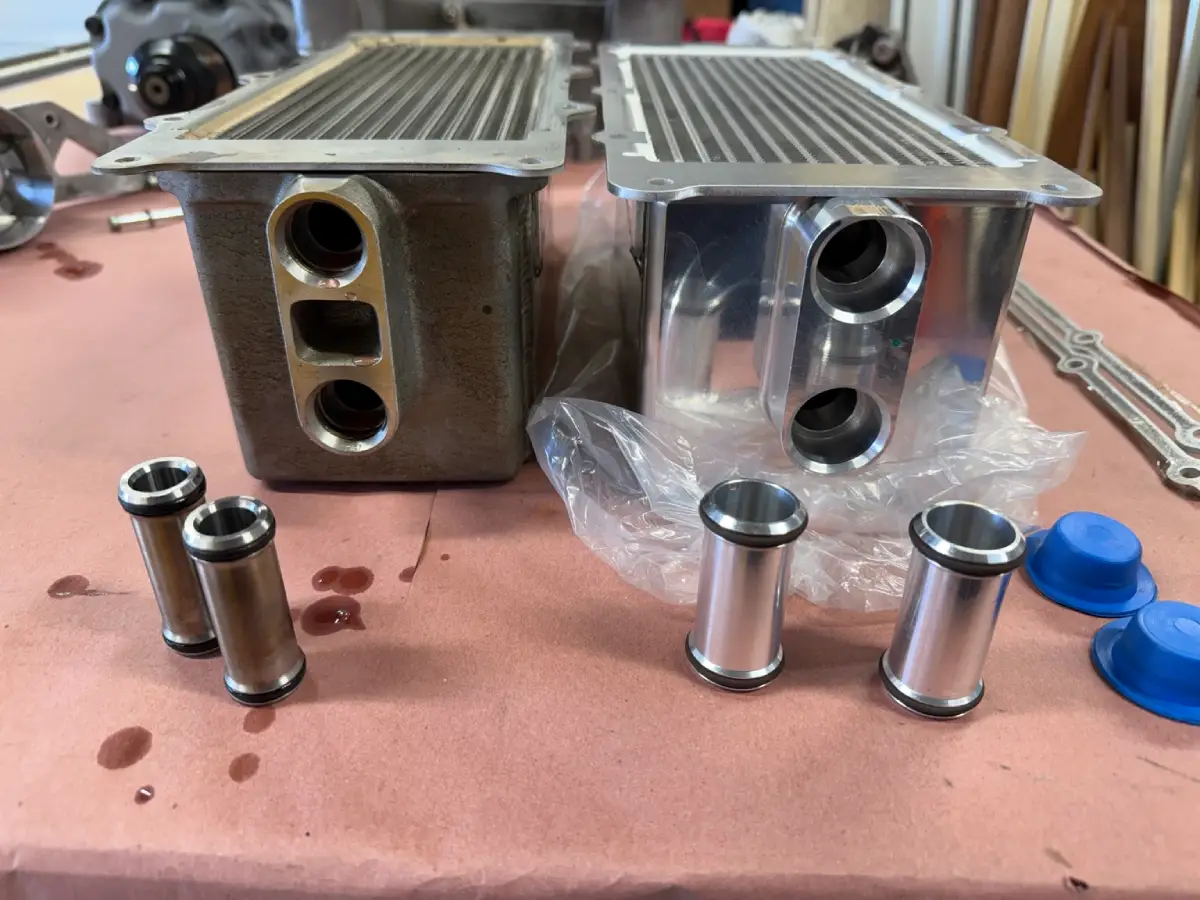
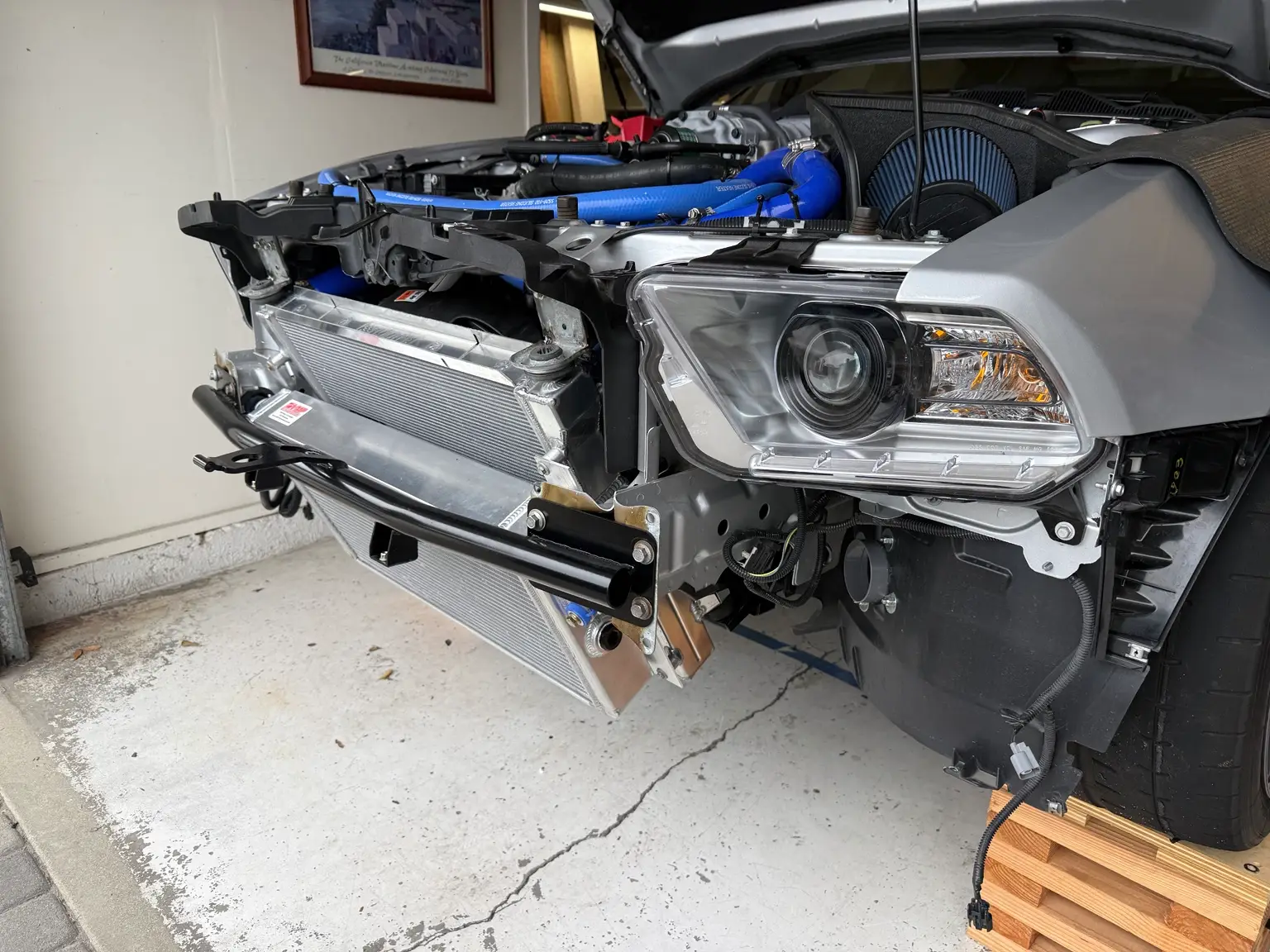
A 2012 Shelby GT500 road course build focused on cooling, aero, suspension, braking, data acquisition, weight reduction and real track testing.
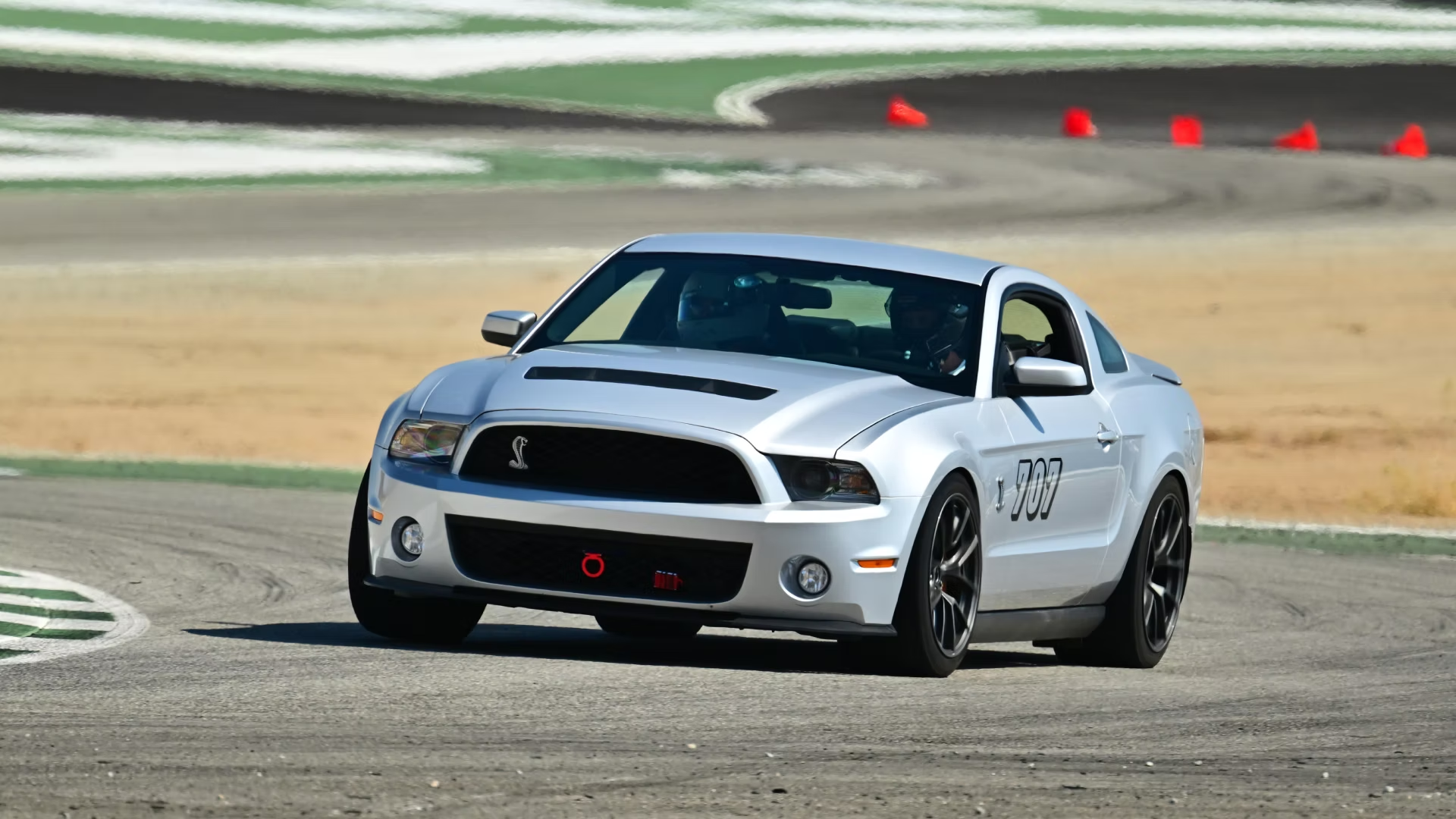
Develop a 2012 Shelby GT500 into a reliable, balanced and increasingly purpose-built road-course car using practical engineering, fabrication and track testing.
My 2012 Shelby GT500 started as a street-based performance car, but the long-term goal has become much more focused: develop the S197 chassis into a capable, reliable and increasingly purpose-built road-course car.
Rather than chasing maximum horsepower, the build is centered on the systems that matter during sustained track use—cooling, airflow management, suspension, braking, tire performance, weight reduction, data acquisition and driver development.
Many of the modifications are designed and fabricated specifically for this car. That includes custom cooling ducting, radiator and heat-exchanger airflow management, hood extraction, component relocation and other changes normally associated with dedicated race cars rather than typical street-driven GT500 builds.
The car is also used as a real-world test platform. Changes are evaluated through track driving, temperature data, lap times, component behavior and hands-on inspection rather than simply being installed for appearance.
This build page documents the complete project while individual technical articles go deeper into each modification, fabrication process, failure, test and lesson learned.
The goal is not to follow the typical modification path. Each system is developed around sustained performance, real track use and measurable results.
Most Shelby GT500 builds concentrate heavily on engine power, supercharger upgrades and straight-line performance. This project takes a different approach.
The objective is to improve the complete car for sustained road-course use.
That means managing airflow through the front of the vehicle, controlling heat from both the supercharger intercooler system and engine cooling system, reducing unnecessary weight, improving braking consistency, refining suspension geometry and collecting useful vehicle data.
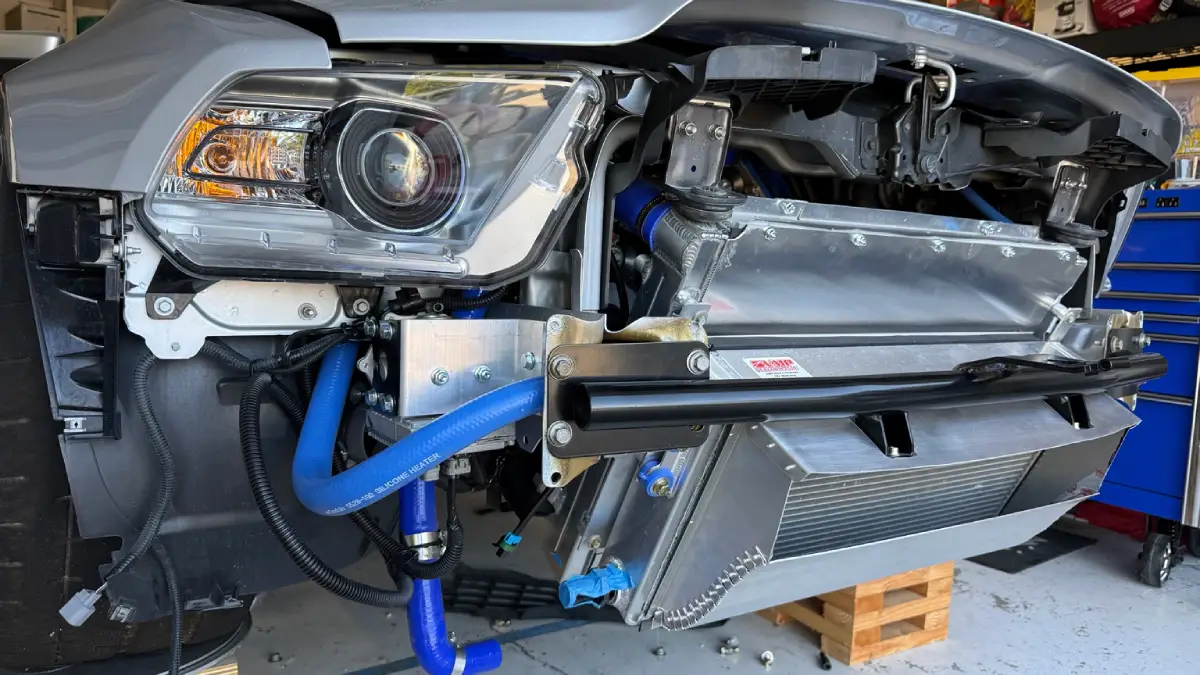
One of the most unusual parts of the project is the cooling and aerodynamic development. The heat exchanger and radiator are being treated as part of a controlled airflow system rather than simply mounting larger heat exchangers behind the factory grille.
Air entering the lower grille is directed through the heat exchanger and radiator, while the upper grille is substantially blocked and the radiator is positioned to help route heated air toward a dedicated hood exit.
The goal is not only cooling efficiency. Managing where the air enters and exits can also reduce pressure inside the engine compartment and potentially reduce front-end lift at speed.
Other serious S197 track builds use pieces of this same philosophy, but complete documented GT500 builds that integrate the supercharger heat exchanger, radiator, inlet ducting and hood extraction as one airflow system appear to be uncommon.
A current snapshot of the major systems, components and setup being developed for sustained road-course use.
Track time is where the setup is validated, problems are exposed and the next round of development begins.
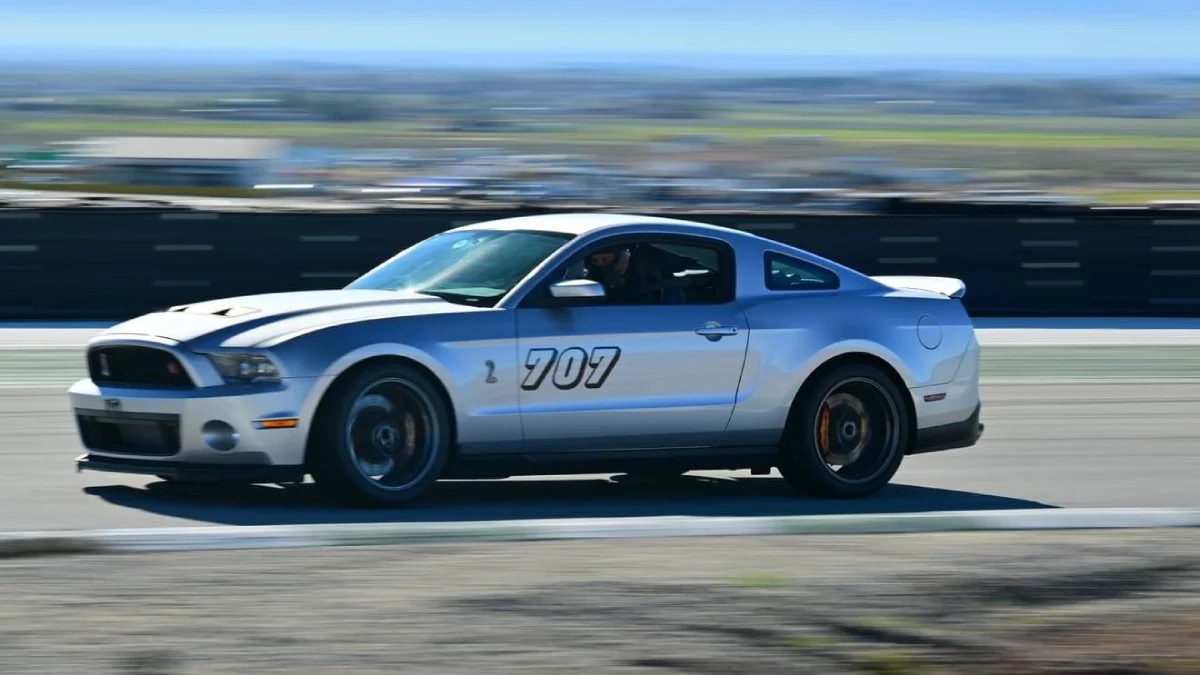
This 2012 Shelby GT500 is built primarily for high-performance driver education (HPDE) and road-course track driving.
The car has been developed through repeated track use at Southern California circuits, with changes evaluated based on driver confidence, temperature management, braking consistency, tire behavior and lap-time improvement.
At Streets of Willow Springs Raceway, the car has run a best lap of 1:30.26 in the current development progression.
The long-term objective is not simply to produce a fast single lap. The greater goal is to build a GT500 that can repeatedly run hard sessions while maintaining stable coolant temperatures, intercooler temperatures, braking performance and predictable handling.
Each future track event will continue to provide data for the next stage of development.
The project has developed in stages as track use exposed new priorities and each modification created the foundation for the next.
The project did not begin as a dedicated race car. My 2012 Shelby GT500 started as a street-based high-performance Mustang with the factory supercharged 5.4L engine, six-speed manual transmission and the basic strengths of the S197 chassis already in place.
Early modifications followed a more traditional GT500 path. The car received a JLT 127 mm carbon-fiber intake, Ford Racing dual 65 mm throttle body, smaller supercharger upper pulley and Lund calibration. Those changes increased performance without fundamentally changing what the car was: a powerful street car that could also be taken to the track.
What changed the direction of the project was spending more time driving it on road courses. Sustained track use began exposing limitations and priorities that are much less obvious during normal street driving.
As track time increased, outright horsepower became less important than making the car predictable, repeatable and capable of running full sessions.
The focus gradually shifted toward the systems that determine whether a heavy, high-powered GT500 can consistently perform on a road course: suspension control, tire grip, braking, chassis geometry, temperature management and driver confidence.
Instead of modifying the car around a dyno number, changes increasingly became responses to things observed at the track. That philosophy eventually became the basis for the entire build.
One of the major steps was replacing the street-oriented suspension with a much more serious road-course setup.
The car now uses MCS two-way adjustable dampers with Vorshlag camber plates and a spring combination of approximately 550 lb/in front and 250 lb/in rear. Alignment and ride-height development have focused on maintaining front tire contact, controlling weight transfer and improving the car's behavior during braking, turn-in and corner exit.
The rear suspension was also developed beyond simply installing stiffer components. Whiteline adjustable rear lower control arms and relocation brackets, a BMR adjustable upper control arm and a Fays2 Watts link provide considerably more control over rear-axle geometry and lateral location.
Steeda X11 extended ball joints and adjustable front end links are part of the broader effort to improve suspension geometry on the lowered chassis rather than treating ride height as an isolated modification.
The wheel and tire package evolved with the chassis.
The car moved to a square configuration using APEX 19 × 11 wheels and 295/35R19 Yokohama A052 tires at all four corners. The square setup provides substantially more front tire than a typical staggered street GT500 arrangement and allows the chassis balance to be developed around comparable tire capability at both ends of the car.
Increasing front mechanical grip has been particularly important on a car with the GT500's engine weight and power. Tire behavior, alignment and suspension settings continue to be evaluated together rather than as separate modifications.
Braking became another major development area as speeds and track use increased.
The current system uses Baer Extreme six-piston brakes front and rear with 15-inch front and 14-inch rear two-piece rotors, track-oriented G-LOC pads and Castrol SRF brake fluid.
A Boss 302 race ABS system was added as part of making the braking system better suited to repeated road-course use. Brake cooling is also being developed with dedicated 4-inch ducting rather than relying only on larger brakes to manage temperature.
The objective is not simply greater peak stopping power. Consistency, pedal feel and repeatable braking performance late in a session are much more important to the direction of the build.
As the project became more specialized, several changes began serving more than one purpose.
The engine and transmission were lowered approximately 3/4 inch using revised mounts. This lowers mass in the chassis while also creating additional packaging opportunities as other systems are redesigned around the track-focused configuration.
The factory driveshaft was replaced with a DSS aluminum one-piece unit, while the Tremec TR-6060 six-speed manual transmission and 3.73 rear gearing remain part of the basic driveline architecture.
These changes reflect a recurring theme of the build: when a component is changed, the effect on weight, geometry, packaging, reliability and serviceability is considered together.
As the GT500 moved farther away from street use, unnecessary street-car equipment became easier to justify removing.
The rear seat has been deleted, and portions of the air-conditioning system including the compressor, condenser and engine-bay plumbing have been removed. Other interior and nonessential components are being evaluated as the car moves toward a more dedicated track configuration.
The goal is not to remove weight simply to produce a lower number on a scale. Priority is given to weight that can be removed cleanly without compromising reliability, safety or the ability to service the car at the track.
Future reductions are being considered in the same way: by looking at where the mass is located and whether removing it meaningfully improves the complete package.
Repeated track use made temperature management one of the most important areas of the project.
The supercharger intercooler circuit was substantially upgraded with a VMP multi-pass heat exchanger, EMP WP32 intercooler pump, VMP high-flow water manifold, larger intercooler plumbing and a dedicated Radium reservoir.
Engine cooling also moved far beyond simply replacing the factory radiator. The car uses a Kenny Brown triple-pass radiator that has been repositioned and leaned approximately 30–35 degrees as part of a completely different approach to airflow management.
At this point the cooling systems stopped being treated as individual components and started being developed as one integrated package.
The current cooling and aerodynamic work represents one of the biggest departures from a conventional GT500 build.
Rather than leaving the radiator and supercharger heat exchanger exposed to whatever air happens to pass through the factory grille openings, the front of the car is being developed around a controlled airflow path.
Air entering through the lower grille is directed through the heat exchanger and radiator using fabricated ducting. The upper grille is substantially blocked so incoming air is concentrated where it is useful rather than pressurizing the engine compartment unnecessarily.
After passing through the heat exchangers, heated air is routed toward the factory hood-extraction area instead of simply accumulating behind the radiator.
The system combines intercooler cooling, engine cooling and airflow management into one development problem rather than treating them as unrelated modifications.
Once the radiator and heat exchanger were treated as part of a controlled duct, cooling development naturally began overlapping with aerodynamic development.
The lower cooling inlet is approximately 24 × 4.5 inches, while the planned hood-side outlet area is approximately 24 × 5.5 inches. The leaned radiator helps establish the path between those two areas.
Managing where air enters and exits the car should improve heat rejection, but it can also reduce pressure buildup inside the engine compartment. Reducing that pressure has the potential to reduce front-end lift while allowing the cooling system to operate with less unnecessary inlet area.
This is why the cooling work has become much more than a radiator upgrade. It is now part of the overall aerodynamic development of the front of the car.
As the project became more specialized, increasingly fewer problems could be solved by simply ordering another bolt-on component.
The cooling package required custom brackets, aluminum panels, sealing surfaces, templates and repeated mockups to package the heat exchanger, leaned radiator, plumbing and ductwork behind the factory S197 bodywork.
That process has changed how the car is developed. Parts are increasingly selected as pieces of a larger system, then mounted or modified around the requirements of the complete car.
The project has become as much about designing, fabricating and testing solutions as it is about choosing aftermarket components.
Track testing continues to determine where development goes next.
RaceChrono, OBD data and CAN-bus experimentation have been used to bring more objective information into a process that originally relied much more heavily on driver feel. The longer-term direction is toward dedicated motorsport data acquisition with additional vehicle and temperature channels.
Lap times are useful, but they are only one measurement. Coolant behavior, intercooler temperature, braking consistency, tire behavior and the driver's ability to repeatedly place the car where intended are equally important.
Each track event provides another opportunity to determine whether a modification actually improved the car rather than simply looking good on a parts list.
The GT500 is now firmly in the transition from modified street car to increasingly purpose-built road-course car.
Current development is centered on completing the sealed heat-exchanger and radiator airflow system, improving hood extraction, refining brake cooling, continuing weight reduction and expanding the amount of useful vehicle data available during track testing.
Safety development is progressing alongside those changes as the interior moves toward a more dedicated track configuration.
The long-term objective is not to create the highest-horsepower GT500 possible. It is to develop a balanced S197 that can repeatedly run hard road-course sessions while maintaining stable temperatures, consistent braking, predictable handling and enough durability to keep learning from the car.
And the build is not considered finished. Each completed system creates the baseline for the next round of testing and development.
The build remains active. Future changes are prioritized around reliability, safety, data and the problems exposed through continued track testing.
The immediate priority is completing the front-end cooling package as a fully sealed airflow system rather than a collection of individual heat exchangers.
The lower grille will feed a controlled duct through the supercharger heat exchanger and leaned Kenny Brown radiator. The remaining work is focused on finalizing the aluminum duct panels, sealing gaps around the heat exchangers and making sure incoming air cannot easily bypass the cores.
The objective is to improve cooling efficiency while using the smallest practical inlet area and controlling where the air travels through the front of the car.
The other half of the cooling system is giving heated air a low-pressure path out of the engine compartment.
The radiator has already been positioned to direct airflow toward the hood outlet, and the next stage is completing the upper ducting and sealing the radiator exit to the hood extraction area.
The upper grille will remain substantially blocked except for the airflow needed for the engine intake. Combined with the lower inlet, sealed heat exchangers and hood exit, the goal is to reduce engine-bay pressure while improving heat rejection and potentially reducing front-end lift at speed.
The system will ultimately be evaluated on track rather than judged only by how it looks in the garage.
Dedicated brake cooling remains an important part of making the car repeatable over longer sessions.
The plan is to complete the 4-inch front brake-duct system with properly positioned front inlets, large ducting and backing-plate connections that deliver cooling air directly to the front rotors.
Once installed, the system can be evaluated alongside pad wear, pedal consistency and brake temperatures during repeated track use.
The interior will continue moving away from a street-car configuration and toward a dedicated track environment.
A major upcoming step is completing the fixed-back seat, roll-bar and six-point harness package as one coordinated safety system rather than installing the components independently.
The current direction is a Watson Racing six-point roll bar with an appropriate motorsport harness and properly mounted race seat. Seating position, harness geometry, head restraint compatibility and driver access will all be considered together.
Safety improvements take priority over additional performance modifications as the car becomes faster and more specialized.
Weight reduction will continue, but the goal is not simply to strip everything possible from the car.
Remaining street equipment will be evaluated based on how much weight can be removed, where that weight is located and whether removing it affects safety, reliability or serviceability.
Likely areas include additional interior components, speakers and unused wiring or hardware left over from systems that are no longer required. Larger changes will only be made when the weight savings justify the fabrication involved.
The longer-term objective is a lighter GT500 without turning the car into something unnecessarily difficult to maintain at the track.
Data acquisition is becoming increasingly important as the car moves beyond basic bolt-on development.
The next stage is moving beyond RaceChrono and conventional OBD data toward a dedicated motorsport logging system capable of recording more of the information already available on the vehicle CAN bus.
Important channels include wheel speeds, brake information, steering angle, engine parameters and additional temperature and pressure sensors that can help explain what the car is doing during a lap.
The long-term direction is an AIM-based system with dedicated logging hardware and additional sensors where the factory data is insufficient.
Better data should make it possible to evaluate changes objectively instead of relying entirely on lap time and driver feel.
Cooling modifications are much more valuable when their effect can actually be measured.
Additional temperature and pressure monitoring is planned for the engine, intercooler and drivetrain so changes to ducting, coolant flow and component placement can be evaluated with real track data.
Particular attention will be given to intercooler temperature behavior, engine coolant performance and other temperatures that become important during sustained road-course sessions.
The goal is to establish repeatable baselines before making major conclusions about whether a modification worked.
The current 19 × 11 square setup has been an important step in improving mechanical grip, but the wheel and tire package may continue to evolve as the chassis develops.
A future direction being considered is moving to a wider 18-inch square package with approximately 12-inch-wide wheels and 315-section track tires.
Any change will be evaluated around actual clearance, suspension geometry, steering behavior, tire availability, gearing and overall performance rather than simply fitting the widest tire possible.
The exhaust system remains another opportunity to reduce weight and improve packaging.
A future system is planned around 1-7/8-inch long-tube headers, compact connections and a substantially lighter exhaust downstream. V-band connections, strategic flex sections and lightweight materials are being considered to make the system easier to service while reducing unnecessary mass.
Heat management will remain important because exhaust routing, cooling airflow and underhood temperature are becoming increasingly interconnected as the front of the car is developed.
The current MCS suspension, square tire package, Watts link and adjustable rear geometry provide a strong platform, but the setup will continue to change as more track data becomes available.
Alignment, ride height, rake, damper settings, spring balance and rear suspension geometry will continue to be adjusted based on tire behavior and driver feedback.
The objective is not to arrive at one permanent setup immediately. The goal is to build a known baseline and make controlled changes that reveal what the S197 chassis responds to.
The Tremec TR-6060 will remain the baseline drivetrain while higher-priority areas of the car are completed.
Longer term, alternative transmission concepts remain an engineering project of interest. A true dual-clutch transmission is particularly appealing because of the potential for fast shifts, paddle control and integration with a modern motorsport-style driver interface.
Any transmission change would need to justify the added complexity, electronics integration, fabrication and cost. It is therefore a long-term development possibility rather than an immediate requirement.
The existing manual transmission is fully capable of continuing the development of the chassis in the meantime.
The most important next step is ultimately more track time.
Future development will be based on repeated sessions, temperature data, braking behavior, tire performance, lap times and driver confidence. The purpose of the modifications is not to create an impressive specification sheet—it is to make the GT500 faster, more consistent and more reliable during sustained road-course use.
Major changes will increasingly be followed by testing before another system is redesigned. That approach should make it easier to determine which modifications actually improve the car.
The project will continue to evolve as track testing identifies the next limitation.
There is no fixed end point for the build. The long-term goal is to keep developing the 2012 Shelby GT500 into a lighter, safer, better-cooled and increasingly data-driven S197 road-course car while documenting what works, what doesn't work, and why each change was made.
Detailed articles documenting the modifications, testing, fabrication and lessons learned while developing this 2012 Shelby GT500 for road-course use.
Read the technical articles behind the build, or explore the AMSOIL products and lubrication strategies used throughout my track testing and vehicle development.